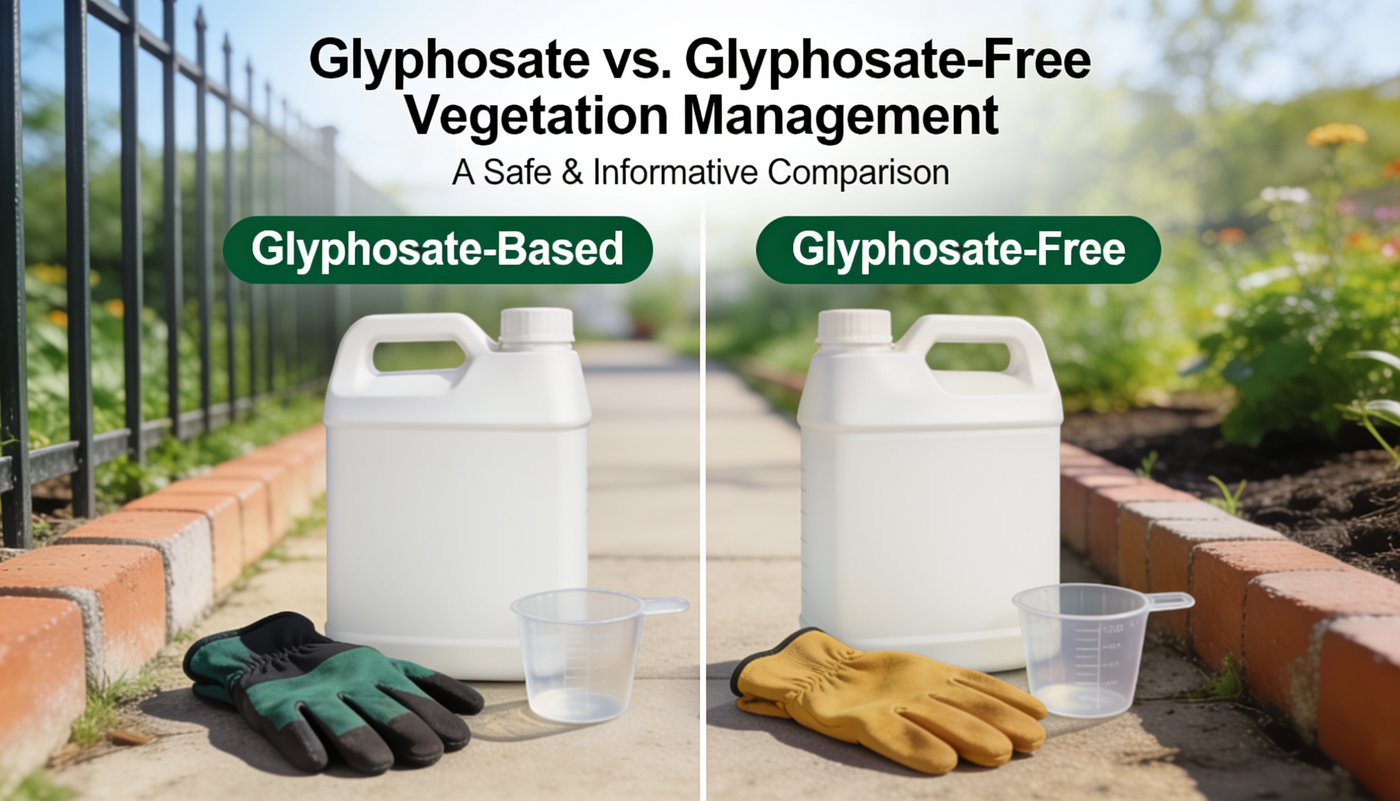
Choosing the right vegetation-management option can feel confusing, especially when product labels mention terms like glyphosate-based, glyphosate-free, concentrate, or land-care formula. Each product type may have a different purpose, application method, and handling requirement.
The most responsible approach is to understand the difference before choosing a product. Whether you are maintaining fence lines, pathway edges, garden boundaries, field borders, or non-crop land areas, the product should always match the intended use and label directions.
What Does Glyphosate-Based Mean?
A glyphosate-based product contains glyphosate as an active ingredient. These products are commonly used in vegetation-management settings where the product label allows. Many glyphosate-based products are non-selective, which means they may affect plants they contact.
Because of this, careful application is very important. These products should not be used casually around desirable plants, garden beds, crops, or sensitive outdoor areas unless the label clearly allows that use.
Glyphosate-based products may be considered for:
- Fence line maintenance
- Field edge management
- Pathway boundary care
- Non-crop land maintenance
- Outdoor boundary areas
- Open land-care spaces
Always read the product label before use and follow local regulations.
What Does Glyphosate-Free Mean?
A glyphosate-free product does not use glyphosate as the active ingredient. Some users may prefer glyphosate-free options depending on their land-care needs, location, product preference, or local requirements.
However, “glyphosate-free” does not automatically mean casual use or risk-free use. Any vegetation-management product should still be handled carefully and used only according to its label.
Glyphosate-free products may be considered by users who are comparing alternative formulas for specific outdoor maintenance needs. The suitability depends on the product label, the area being maintained, and the surrounding environment.
Main Difference Between Glyphosate-Based and Glyphosate-Free Options
The main difference is the active ingredient and product formulation. Glyphosate-based products contain glyphosate, while glyphosate-free products use a different formula.
However, both categories require responsible handling.
A simple comparison:
| Feature | Glyphosate-Based Product | Glyphosate-Free Product |
|---|---|---|
| Active ingredient | Contains glyphosate | Does not contain glyphosate |
| Use approach | Label-directed land-care use | Label-directed alternative formula use |
| Suitable areas | Depends on product label | Depends on product label |
| Handling requirement | Careful handling required | Careful handling required |
| Around desirable plants | Use caution | Use caution |
| Best decision factor | Product label and intended area | Product label and intended area |
The safest choice is not based only on the product name. It should be based on the label, the application area, and the user’s ability to follow instructions correctly.
Choosing Based on the Area
Different outdoor areas may need different maintenance methods. Before choosing any product, identify the area clearly.
Fence Lines
Fence lines can be difficult to maintain because unwanted growth often appears around posts and corners. A label-directed vegetation-management product may be considered where suitable.
Pathway Edges
Pathways and walkways should remain clear and accessible. Any application should be directed carefully and kept away from desirable plants.
Garden Boundaries
Garden boundaries need extra attention because useful plants may be nearby. Avoid broad application near flowers, crops, or plants that should remain.
Field Borders
Field borders and farm edges may require planned maintenance depending on the season and growth conditions.
Non-Crop Land Areas
Open spaces, storage areas, and unused corners may need periodic maintenance. Product suitability should always be checked on the label.
When to Consider a Glyphosate-Based Product
A glyphosate-based option may be considered when the product label supports the intended land-care use and the user can apply it carefully.
It may be suitable for users who need a label-directed option for certain outdoor maintenance areas such as fence lines, pathway edges, field borders, or non-crop spaces.
Before choosing this type of product, check:
- Whether the product label matches the intended use
- Whether desirable plants are nearby
- Whether local regulations allow the intended use
- Whether weather conditions are suitable
- Whether the user can follow all handling instructions
Avoid using glyphosate-based products near plants that should remain unless the label clearly allows the specific use.
When to Consider a Glyphosate-Free Product
A glyphosate-free option may be preferred by users looking for an alternative formula for outdoor vegetation management.
It may be considered when:
- The user prefers a non-glyphosate formula
- The product label supports the intended area
- The application area is suitable
- Local rules allow the intended use
- The user can follow the label instructions correctly
Even with glyphosate-free products, responsible handling is still required. Always read the full label before use.
Important Safety and Handling Notes
Both glyphosate-based and glyphosate-free products should be handled responsibly. Do not assume one option removes the need for caution.
Before using any vegetation-management product:
- Read the full product label
- Use only as directed
- Avoid application during windy conditions
- Keep away from children and pets
- Protect nearby desirable plants
- Store the product in its original container
- Do not transfer into unmarked bottles
- Follow local rules and regulations
- Dispose of containers according to local guidance
Safe handling protects people, pets, plants, and surrounding outdoor spaces.
Common Mistakes to Avoid
Many problems happen when users choose a product without checking whether it is suitable for the area.
Avoid these mistakes:
- Choosing based only on quick-result claims
- Using a product without reading the label
- Applying near desirable plants without care
- Using more product than instructed
- Applying during windy weather
- Treating all outdoor areas the same way
- Storing the product in unsafe locations
- Ignoring local regulations
Responsible use is not only about product choice. It is also about planning, preparation, and careful handling.
How to Choose the Right Option
The best option depends on the area, the product label, and the user’s maintenance goal.
Before choosing between glyphosate-based and glyphosate-free options, ask:
- What area needs maintenance?
- Are desirable plants nearby?
- Does the product label allow this use?
- Are local rules being followed?
- Can the product be handled and stored safely?
- Is this the right method, or would manual removal or trimming be better?
A careful decision helps avoid unnecessary use and supports responsible land care.
Final Thoughts
Glyphosate-based and glyphosate-free products both have a place in vegetation-management discussions, but neither should be chosen casually. The right option depends on the intended area, label directions, local regulations, and safe handling requirements.
For fence lines, pathway edges, garden boundaries, field borders, and non-crop land areas, the best approach is always planned, careful, and label-based.
Before using any land-care product, read the label fully, follow local rules, protect nearby desirable plants, and use only as directed.