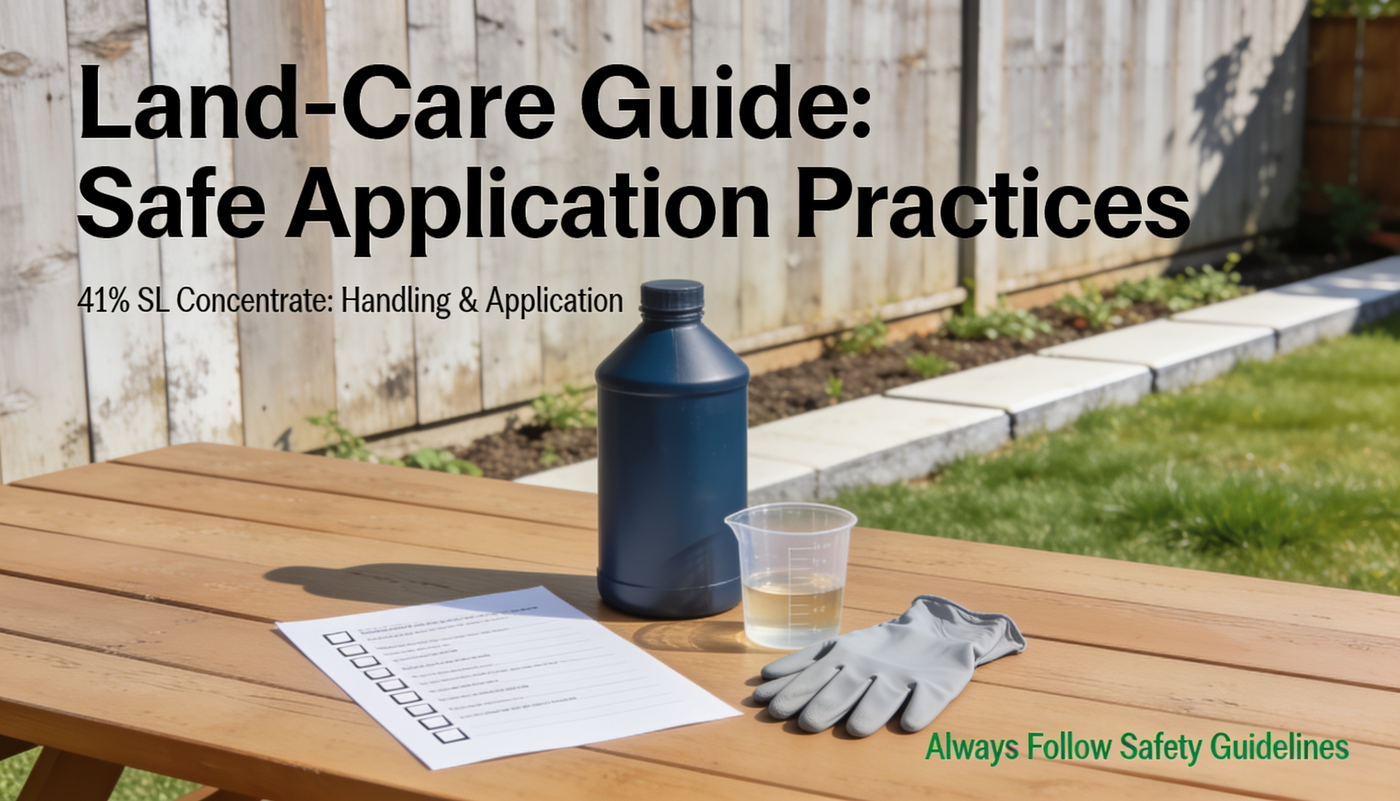
When choosing a product for outdoor land care, many users come across terms such as “41% SL concentrate.” These words may look technical, but they are important for understanding the product type, how it should be handled, and why label directions matter.
A 41% SL concentrate is commonly associated with certain vegetation-management products used in suitable outdoor areas. However, it should never be treated as a casual-use product. It must be selected carefully, handled responsibly, and used only according to the product label and local regulations.
What Does 41% SL Concentrate Mean?
The term “41% SL concentrate” describes the formulation and concentration of a product.
“41%” refers to the concentration level mentioned on the product label.
“SL” usually means soluble liquid. This indicates that the product is in a liquid form designed to mix according to label directions.
“Concentrate” means the product is not normally used directly from the container unless the label specifically states so. Concentrates are usually prepared according to the instructions provided by the manufacturer.
Because this type of product is concentrated, careful reading of the label is very important before use.
Why Product Labels Matter
The product label is the most important guide for any land-care product. It explains where the product may be used, how it should be prepared, what safety steps are needed, and what areas should be avoided.
Before using any 41% SL concentrate product, users should check:
- The intended application areas
- Preparation instructions
- Safety handling guidance
- Storage instructions
- Environmental precautions
- Local usage requirements
- Disposal instructions
A product should only be used when the label clearly supports the intended use.
Where 41% SL Concentrate Products May Be Considered
Some 41% SL concentrate products are used for vegetation management in outdoor land-care settings where the label allows. These may include areas that require regular maintenance and controlled application.
Common land-care areas may include:
- Fence lines
- Pathway edges
- Field boundaries
- Non-crop land areas
- Outdoor storage spaces
- Driveway edges
- Open boundary areas
Care should always be taken near desirable plants, garden beds, crops, water sources, and public-access areas.
Understanding Concentrated Formulas
A concentrated formula requires more attention than a ready-to-use product. The user must follow the product label closely to understand preparation, handling, and application requirements.
Using more than instructed does not mean better maintenance. Overuse can create unnecessary risk and may affect areas that were not intended for treatment.
Responsible use means:
- Preparing only as directed
- Applying only where suitable
- Avoiding unnecessary repeat use
- Protecting nearby desirable plants
- Following all safety instructions
- Storing the container correctly after use
Responsible Handling Before Use
Before handling any concentrate product, users should prepare the area and review the label carefully.
A simple pre-use checklist includes:
- Read the complete product label
- Confirm the area is suitable
- Check weather conditions
- Avoid windy conditions
- Keep children and pets away
- Protect nearby plants that should remain
- Use protective handling as instructed
- Prepare only the required amount
- Store the container securely after use
This helps reduce mistakes and supports safer land maintenance.
Common Mistakes to Avoid
Mistakes often happen when users treat concentrated products like ordinary garden-care items. A 41% SL concentrate should be handled with more care.
Avoid these common mistakes:
- Using the product without reading the label
- Applying in areas not listed on the label
- Preparing more product than needed
- Using more than the instructed amount
- Applying during windy weather
- Allowing contact with desirable plants
- Storing the product in an unmarked container
- Leaving the product within reach of children or pets
Careful handling is part of responsible vegetation management.
41% SL Concentrate vs Ready-to-Use Products
A concentrate and a ready-to-use product are not the same.
A concentrate usually requires preparation according to label instructions. It may be suitable for users who are comfortable following product directions carefully and managing larger outdoor maintenance areas.
A ready-to-use product may be simpler for smaller spaces, but users must still follow the label. Convenience does not remove the need for responsible handling.
The best choice depends on:
- The size of the area
- The type of maintenance needed
- The user’s experience
- The product label
- Local rules and regulations
- Nearby plants and surroundings
Safety and Storage Guidance
Proper storage is very important for concentrated products. The product should remain in its original container with the label clearly visible. It should be stored securely in a dry place away from children, pets, food items, and household-use areas.
Basic safety guidance includes:
- Keep the container tightly closed
- Do not transfer into drink bottles or unmarked containers
- Store away from direct access
- Follow protective handling instructions
- Wash hands after handling
- Keep away from water sources unless the label allows use in that setting
- Dispose of empty containers according to local rules
Safe storage helps protect people, pets, plants, and the surrounding environment.
How to Choose a 41% SL Concentrate Product Responsibly
When choosing a 41% SL concentrate product, avoid selecting based only on strong claims or quick-result wording. A responsible choice should be based on product suitability and label guidance.
Before purchasing, check:
- Whether the product label matches your intended use
- Whether the area is suitable for application
- Whether you understand the preparation instructions
- Whether you can follow the safety guidance
- Whether local regulations allow the intended use
The right product is the one that fits the area, the purpose, and the instructions clearly.
Final Thoughts
A 41% SL concentrate is a product type that requires careful handling and responsible use. It may be suitable for certain land-care and vegetation-management needs where the label allows, but it should never be used without reading and following the full product instructions.
For outdoor boundary care, fence lines, pathway edges, and non-crop land maintenance, the best approach is always planned, careful, and safety-focused.
Before using any concentrate product, read the label, follow local regulations, protect desirable plants, and use only as directed.